About
Camano 31
A Boat Built for These Waters
The story of the Camano 31 begins where the Fraser River meets the Strait of Georgia, in the boatbuilding community of Delta, British Columbia. It was here, in the mid-1990s, that Camano Marine Ltd. set out to build a different kind of cruising boat—one designed not for the open ocean or the Intracoastal Waterway, but specifically for the protected yet demanding waters of the Pacific Northwest.
The brief was clear: create a boat that could cruise comfortably at displacement speeds while burning minimal fuel, yet also get up on plane and make 12 knots when weather windows were short or destinations were distant. The boat needed to handle the chop of the Strait of Georgia, the currents of Active Pass, and the occasional slog into a southeast wind. It needed to keep its crew warm and dry through the gray days of spring and fall that bookend the summer cruising season. And it needed to be small enough for a couple to handle confidently, while offering enough space to live aboard for weeks at a time.
The result was the Camano 31—a pocket trawler that would go on to earn a devoted following among Pacific Northwest boaters.
Design and Construction
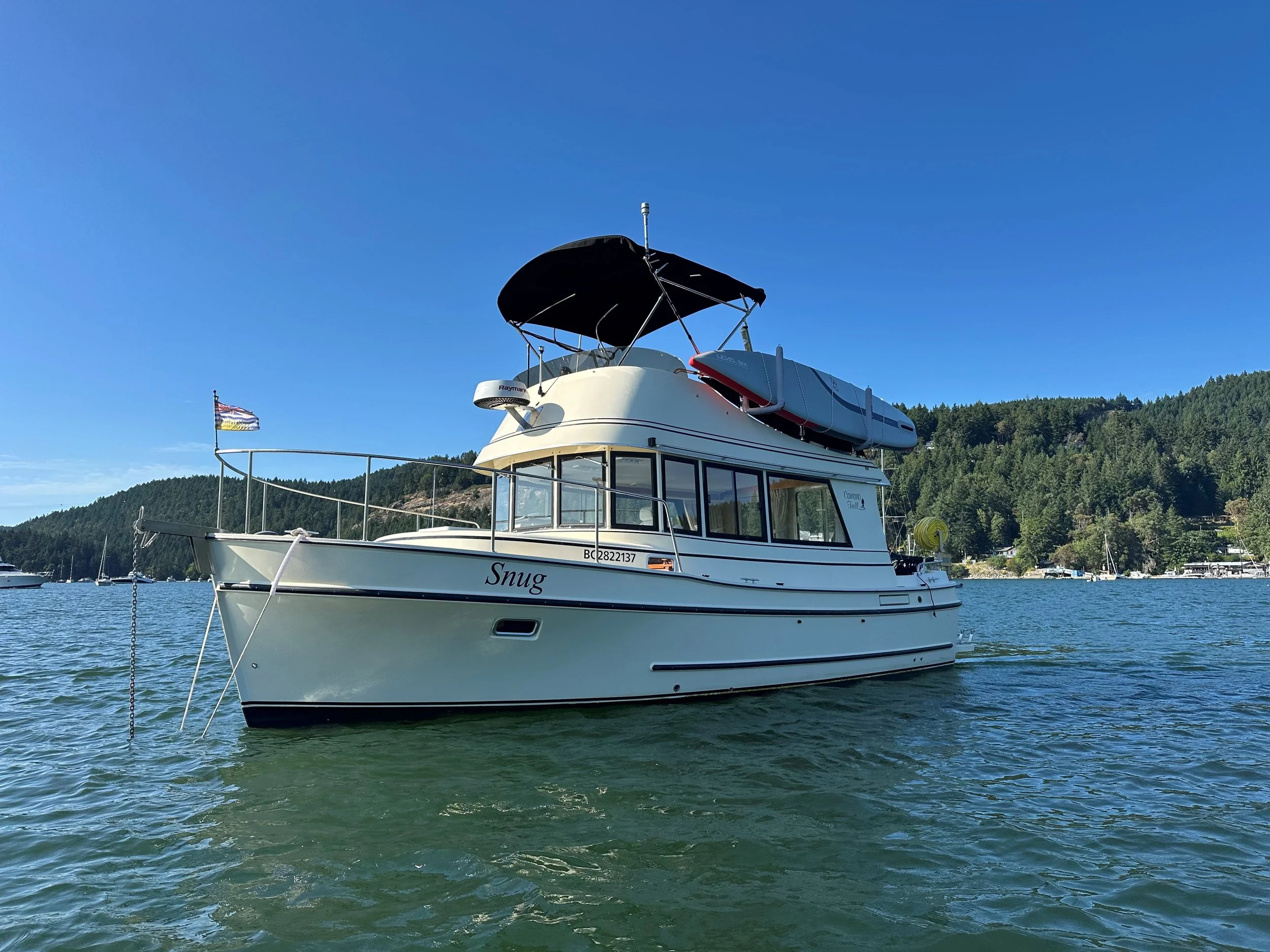
The Camano measures 28 feet on deck, stretching to 31 feet overall with its integrated swim platform and anchor roller. This is a deliberate size—large enough to be genuinely capable, small enough to remain manageable. The hull is solid fiberglass below the waterline, transitioning to a fiberglass-balsa sandwich above for reduced weight and improved insulation. The construction is robust throughout, reflecting the boat's workboat heritage and the builders' understanding of what Pacific Northwest conditions demand.
The Camano was offered in two configurations. The Troll model features a flybridge, providing an elevated helm position with commanding views in all directions—a significant advantage when navigating crowded anchorages or threading through log debris. The Gnome model, discontinued early in production, offered the same hull and interior without the flybridge, resulting in a slightly simpler and more fuel-efficient vessel.
The raised pilothouse is central to the Camano's appeal. With windows on all sides and a helm position that allows the captain to see over the bow while seated, the pilothouse offers visibility that many larger boats struggle to match. This becomes particularly important in the Pacific Northwest, where fog, rain, and short winter days mean you're often navigating in less-than-ideal conditions.
Below the pilothouse, the layout is sensible and well-considered. A V-berth forward provides sleeping accommodations with good ventilation from an overhead hatch. The enclosed head includes a shower—a luxury that makes extended cruising considerably more comfortable. The galley, while compact, is genuinely functional, with a two-burner propane stove, refrigerator, and enough counter space to prepare real meals. The salon offers comfortable seating with large windows that fill the space with natural light and provide views of wherever you've chosen to anchor.
The Engine Room
Camano owners tend to be engaged with their boats' mechanical systems, and the engine room is designed with accessibility in mind. The standard engine for most of the production run was the Volvo TAMD41P, a 200-horsepower six-cylinder turbocharged diesel that has proven reliable across thousands of hours and decades of service. Earlier boats were equipped with various Volvo four- and six-cylinder engines, while later production offered the Volvo D4 and, from 2009, the Yanmar 6BY.
The engine room provides reasonable access for routine maintenance—oil changes, filter replacements, belt inspections—though some tasks require the flexibility that comes with smaller hands or a willingness to contort. Twin aluminum fuel tanks hold between 92 and 130 gallons depending on hull number, providing range that allows for extended cruising without constant fuel stops.
Fuel efficiency is one of the Camano's defining characteristics. At displacement speeds of 6-7 knots, consumption drops to around one gallon per hour—a figure that makes spontaneous cruising practical and keeps fuel costs manageable even as prices rise. Push the throttle forward and the boat will plane, reaching speeds of 10-12 knots, though fuel consumption increases accordingly. Most owners find a comfortable rhythm somewhere in between, matching speed to conditions and schedule.
Production History
Camano Marine Ltd. produced approximately 268 hulls before the company changed hands. In 2007, Bracewell Marine Group acquired the design and continued production briefly before the operation moved again in 2008 to Camano Yachts America. Production continued through 2009, when the combination of the financial crisis and changing market conditions brought manufacturing to an end.
Today, Camanos trade on the used market, where they command steady prices that reflect their quality construction and devoted ownership. The boats have aged well—a testament to solid materials and thoughtful design—and many continue to cruise actively with several thousands of hours on their engines.
Specifications
Length Overall
31 ft (including swim platform and anchor roller)
Length on Deck
28 ft
Beam
10 ft 6 in
Draft
3 ft
Fuel Capacity
92 gal (through Hull 179) / 130 gal (Hull 180+)
Fresh Water
~67 gal (two tanks)
Holding Tank
~14.5 gal
Engine (most common)
Volvo TAMD41P 200 HP
Cruising Speed
7-8 knots (displacement) / 10-12 knots (planing)
Fuel Consumption
~1 gal/hr at displacement / ~4-6 gal/hr planing
The Ownership Experience
Owning a Camano is, in many ways, owning a piece of Pacific Northwest boating history. These boats were designed by people who understood the local waters, built by craftsmen who took pride in their work, and refined over years of production based on feedback from owners who actually used them.
The community that has grown up around these boats reflects this heritage. Camano owners tend to be practical, hands-on people who enjoy maintaining their own vessels and sharing what they've learned with others. Technical knowledge flows freely through the forum, at rendezvous gatherings, and in chance encounters at marinas throughout the region. When something breaks or needs upgrading, chances are good that another owner has already solved the problem and documented the solution.
For prospective buyers, this community represents a significant asset. The Camano is not a boat you purchase and then figure out alone. From the day you take ownership, you have access to decades of accumulated knowledge about these specific vessels—their quirks, their common issues, their hidden strengths. This collective wisdom, freely shared, makes the ownership experience richer and the learning curve considerably gentler.
Why the Camano Endures
In a world of increasingly large and complex boats, the Camano 31 represents something different: a boat sized for the cruising that most people actually do. It's large enough to be comfortable for extended trips, small enough to handle without crew, efficient enough to cruise without watching fuel gauges anxiously, and capable enough to handle the conditions these waters occasionally deliver.
The boats are aging now—the newest are over fifteen years old, the oldest approaching thirty—but they continue to cruise. Owners invest in maintaining and upgrading them because the fundamental design remains sound and because there's nothing quite like them on the market today. For those who find their way to a Camano, whether through careful research or happy accident, the boat often becomes a long-term companion for exploring the Pacific Northwest.